 Capilla Real de Granada
What to See Inside the Royal Chapel: A Visit in Order
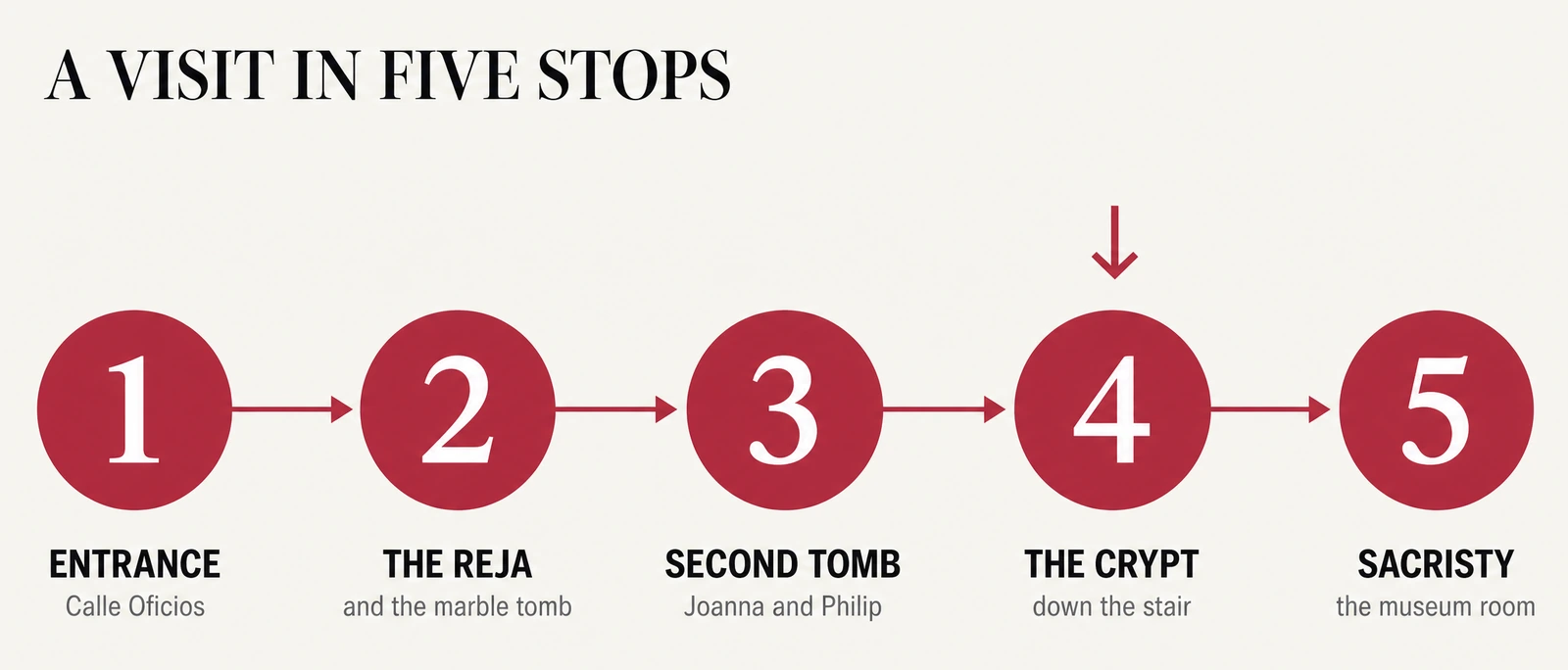
The route, in five stops
The Chapel is one room and a crypt, so there is no wrong turn to take — but there is an order the building was designed to be read in, and it is not the order most people walk it. Most drift straight to the marble and leave without going down. This is the sequence:
Through the door on Calle Oficios
You come in from a narrow pedestrian lane, with no forecourt and no grand facade. Bags and coats first; photography stops here.
The reja, and the marble behind it
Straight ahead, the gilded screen. Behind it, Fancelli’s cenotaph — Ferdinand in armour, Isabella in plain court dress. Look at the hands.
The second tomb, to the right
Joanna and Philip, by Ordóñez. Larger and more elaborate than the parents’. Nearly everyone is surprised by this.
Down the stair to the crypt
A short flight behind a grille. Five plain lead coffins on a bare stone floor. This is the stop people skip and the one they remember.
Back up to the sacristy-museum
The crown, the sword, and Isabella’s own Flemish paintings. Budget more time here than you think you need.
How long each stop takes
Thirty to forty-five minutes is the honest figure for the whole visit, and it divides up roughly like this. The museum is the part that runs over.
| Stop | Typical time | What to look for |
|---|---|---|
| The reja and cenotaph | 10–15 min | Ferdinand’s hands on his sword; Isabella’s undecorated dress |
| Joanna and Philip’s tomb | About 5 min | That it is grander than the tomb of the monarchs who commissioned the building |
| The crypt | 5–10 min | Five lead coffins, an initial on each lid, and the small one belonging to the infant prince Michael |
| The sacristy-museum | 10–20 min | Isabella’s crown and sword case, then her Flemish panels — Memling, van der Weyden, Bouts |
| Whole visit | 30–45 min | An hour if you read the museum labels properly |
Times assume a normal day. Right at opening and between 14:00 and 16:00 the room is quietest, and every stop is faster.
First: the reja and the Fancelli cenotaph
You enter and face the reja — an ornate gilded wrought-iron screen finished in 1520 by Master Bartolomé de Jaén. It is the first thing you see, and it sets the tone: you are looking at the Catholic Monarchs through a barrier. Behind the reja stands the marble cenotaph by the Florentine Domenico Fancelli, completed in 1517 in Carrara marble. Ferdinand lies in full armour with his hands at his sword. Isabella is in plain court dress. The contrast is deliberate. Ferdinand is represented as a warrior-king; Isabella is not. A guide will point this out and it will land differently than reading it on a label.
Second: the Ordóñez mausoleum
To the right stands a second, larger and more elaborate tomb. This is the mausoleum of their daughter Joanna (“the Mad”) and her husband Philip (“the Handsome”), begun by Bartolomé Ordóñez. Visitors consistently find it surprising — the daughter’s tomb is grander than her parents’. That is worth knowing before you see it; it changes how the room reads.
Third: down to the crypt
A short stair leads down behind a grille. The crypt is a small bare chamber, cool (genuinely cold, even in 25°C heat outside). Inside are five plain lead coffins, each with an initial on the lid. The Catholic Monarchs lie on a central stone platform. Joanna and Philip rest on benches. And in a smaller coffin lies the infant prince Michael. You look at them through the grille and cannot enter. The distance between the marble above and the lead below — that is the visit’s emotional centre. Reviewers say so without being prompted.
Fourth: the sacristy-museum
Back upstairs, the sacristy-museum. Isabella’s crown and Ferdinand’s sword are in a case. But most of the room is her painting collection: Flemish panels by Memling, van der Weyden, Bouts and Juan de Flandes, plus Botticelli and Berruguete. One of the best small collections of Flemish primitives anywhere. Almost no visitor arrives expecting a museum; everyone leaves talking about it.
Bring a layer
The chapel stays cool year-round. Bring a cardigan or a light jacket even in summer. The stones radiate cold and the air moves. See what to wear, who lies in the crypt, and why you cannot take photos.
The crypt is the heart of it. Stand at the grille and let the contrast sink in. A guide or a moment of silence does what a label cannot.
Frequently asked questions
What does the reja do?
The gilded wrought-iron screen frames the view of the cenotaph. It was finished in 1520 by Master Bartolomé de Jaén. You look at the monarchs through it.
Why is Joanna’s tomb bigger than her parents’?
It is more elaborate, yes. The Ordóñez mausoleum for Joanna and Philip was begun after the Fancelli cenotaph and represents a shift in sculptural style. The detail is worth asking a guide about.
What is in the crypt?
Five lead coffins. The Catholic Monarchs in the centre, their daughter Joanna and Philip on benches, and the small coffin of the infant prince Michael. You view them through a grille; you do not enter. See who is buried here for the full explanation.
Is the museum worth spending time on?
Yes. Isabella’s painting collection is the reason most visitors linger. Flemish primitives, Botticelli, Berruguete. Most arrive expecting a tomb and leave talking about the paintings.
Why is it so cold inside?
Stone holds cold. The chapel stays at a steady cool temperature year-round. Even in August heat, bring a layer. See what to wear.